Competitor Price Monitoring: A Practical (and Compliant) Guide
Last updated: November 8, 2026. Product and pricing details were checked on brightdata.com on this date. Some links are affiliate links — see our Affiliate Disclosure. This article is not legal advice.
Knowing what competitors charge — and when they change prices — helps e-commerce teams price smarter. Most price monitoring is built on collecting publicly available product pages at regular intervals. Here are the main approaches, a simple setup and the compliance basics.
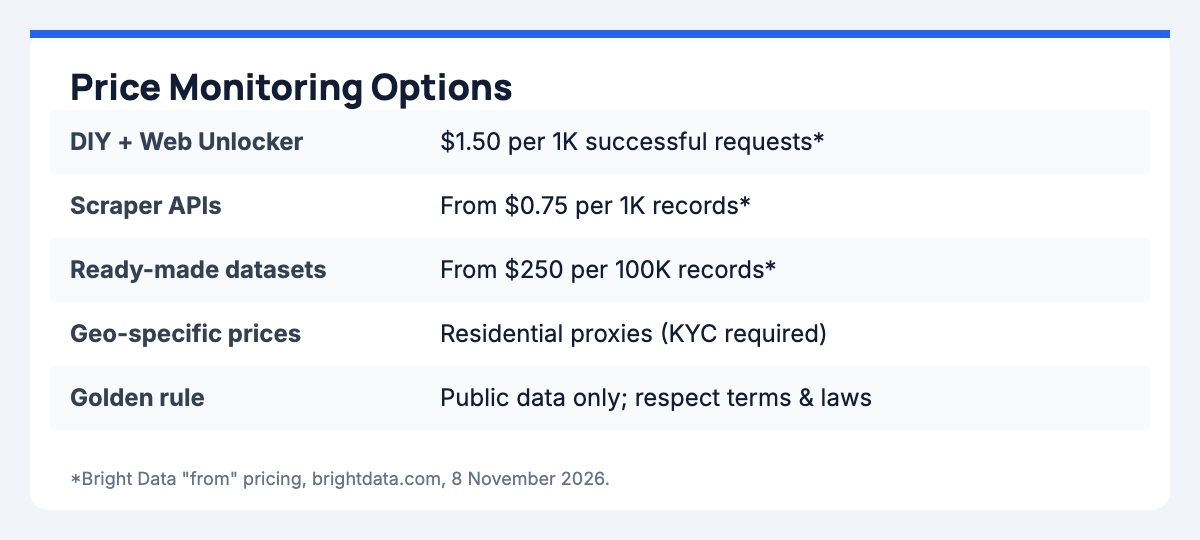
Three Ways to Get Price Data
| Approach | Effort | Best for |
|---|---|---|
| Build your own scraper with Web Unlocker | Medium | Custom targets, full control |
| Use Scraper APIs | Low | Common marketplaces and sites |
| Buy datasets | Lowest | Large-scale, one-off analysis |
Step-by-Step Setup
- List competitor product URLs and match them to your SKUs.
- Choose a collection method (Web Unlocker or Scraper API).
- Collect daily (or hourly for fast-moving categories).
- Normalize prices, currency, shipping and stock status.
- Alert your team when a competitor changes price beyond a threshold.
Compliance Basics
- Collect only publicly available information; avoid personal data.
- Review each website’s terms and applicable laws in your jurisdiction.
- Rate-limit requests so you do not burden target sites.
- Use providers with clear compliance controls — Bright Data, for example, requires KYC for residential proxies and blocks government sites.
Recommended Tool
Bright Data covers every approach above: Web Unlocker for custom targets, Scraper APIs for popular sites and datasets for bulk analysis, plus 5,000 free API credits per month to start.
Start with Brightdata.comRelated: Proxy types explained · Bright Data review.